
 Email: sales@slxytech.com
 WhatsApp / Wechat:8617062388866
 Phone:+86 17062388866
Description
The Triconex 3720 is a high-integrity analog output (AO) module designed for use in the Tricon® and Triconex® Safety Instrumented Systems (SIS), providing fail-safe control of critical field devices such as control valves, variable frequency drives, and actuators. As part of Schneider Electric’s Triconex portfolio—renowned for its Triple-Modular Redundant (TMR) architecture—the Triconex 3720 delivers eight independent, isolated 4–20 mA current loop outputs with diagnostic coverage that meets IEC 61508 SIL3 and IEC 61511 requirements. Each output channel is triplicated across three independent processing lanes, enabling continuous operation even in the event of a single or dual hardware fault through real-time voting and automatic fault masking.
Deployed globally in oil & gas, chemical processing, power generation, and pharmaceutical facilities, the Triconex 3720 ensures deterministic and reliable signal transmission from the safety controller to final elements in emergency shutdown (ESD), burner management (BMS), and turbine protection systems. Unlike conventional DCS analog outputs, the Triconex 3720 integrates comprehensive self-diagnostics—including open-circuit detection, short-circuit monitoring, and output deviation alarms—that are reported directly to the TriStation 1131 engineering workstation. This enables predictive maintenance and compliance with functional safety lifecycle standards. The module’s robust design, combined with galvanic isolation and surge protection, makes the Triconex 3720 a trusted component in mission-critical automation infrastructures where human safety and environmental protection are non-negotiable.
 Technical Specifications
| Parameter Name | Parameter Value |
|---|---|
| Product Model | 3720 |
| Manufacturer | Schneider Electric (Triconex) |
| Product Type | Triple-Modular Redundant (TMR) Analog Output Module |
| Number of Channels | 8 independent output channels |
| Output Signal Type | 4–20 mA (sink/source capable, HART compatible) |
| Output Load Range | 0–750 Ω (at 24 VDC loop supply) |
| Accuracy | ±0.1% of full scale at 25°C |
| Resolution | 16-bit D/A conversion |
| Isolation | Channel-to-channel and channel-to-backplane: 500 VAC RMS (1 min) |
| Redundancy Architecture | Triple-modular redundant (TMR) with 2oo3 voting |
| Diagnostic Coverage | >99% per IEC 61508 (detects open/short circuits, drift, latch-up) |
| Operating Temperature | 0°C to +60°C (32°F to 140°F) |
| Power Consumption | Approx. 5.5 W (from Tricon chassis backplane) |
| Certifications | TÜV Rheinland certified to IEC 61508 SIL3, IEC 61511, EN 61326-3-1 |
| Compatible Systems | Tricon v9/v10/v11, Triconex TCM, M-series chassis |
Main Features and Advantages
Triple-Modular Redundancy for Zero Single Point of Failure: The 3720 implements true TMR architecture—each analog output is generated by three independent microprocessors and voted upon before being sent to the field device. This eliminates single-point failures and allows the system to tolerate up to two simultaneous faults without causing a spurious trip or dangerous failure, a cornerstone of SIL3-certified safety systems.
High-Precision and HART-Compatible Outputs: With ±0.1% accuracy and 16-bit resolution, the 3720 delivers stable, noise-immune 4–20 mA signals capable of driving long cable runs to remote actuators. Its outputs are fully compatible with HART communicators, enabling calibration and diagnostics without interrupting the safety loop—critical for maintaining asset integrity during partial stroke testing.
Comprehensive Built-In Diagnostics: Every 3720 continuously monitors output health, detecting open wires, short circuits, excessive load, or internal component drift. Faults are logged with time stamps and reported to the TriStation 1131 software, supporting compliance with IEC 61511 proof test requirements and reducing manual verification efforts.
Seamless Integration with Tricon Ecosystem: The 3720 plugs directly into standard Tricon chassis (e.g., 4328, 4329) and communicates via the proprietary high-speed Sync and Bus cables that synchronize all three legs of the TMR system. Configuration is performed in TriStation 1131 using intuitive function blocks, with no need for external isolators or signal conditioners.
Robust Industrial Design: Enclosed in a rugged metal housing with conformal coating, the 3720 withstands harsh environments including high humidity, vibration, and electrical transients common in refineries and offshore platforms. Its galvanic isolation protects the controller from ground loops and field-induced surges.
Application Field
The 3720 is extensively used in safety-critical applications where precise analog control must be maintained under fault conditions. In oil & gas upstream operations, it modulates blowdown valve positions during ESD events on offshore platforms, ensuring controlled depressurization without over-stressing pipelines. In LNG terminals, the 3720 drives cryogenic valve actuators in fire & gas suppression systems, where reliability at extreme temperatures is paramount.
In power plants, the 3720 interfaces with turbine bypass valves and boiler feedwater controls as part of a turbine protection system (TPS), providing fail-safe analog commands that prevent catastrophic overspeed or thermal stress. Chemical and petrochemical facilities deploy the 3720 in reactor temperature control loops, where a spurious output could trigger runaway reactions—its TMR design ensures such scenarios are virtually eliminated.
Pharmaceutical and biotech manufacturers also utilize the 3720 in sterile process skids requiring validated safety interlocks, leveraging its audit-ready diagnostics and compliance with GAMP5 guidelines. Across all these sectors, the 3720 serves as the trustworthy link between the Triconex logic solver and the physical world, turning safety strategies into actionable, fail-operational control signals.
 Related Products
3700: Analog input module (8-channel, 4–20 mA), complementary to 3720 in closed-loop SIS.
3635: Digital output module (24 VDC, TMR), used for on/off actuation alongside 3720 analog control.
3501E: High-density digital input module for emergency pushbuttons and limit switches.
4328 / 4329: Tricon main chassis that houses 3720 and other I/O modules.
MPU (Model 3008): Main processor unit that coordinates TMR voting across all modules including 3720.
TriStation 1131: Engineering software used to configure, test, and diagnose 3720 functionality.
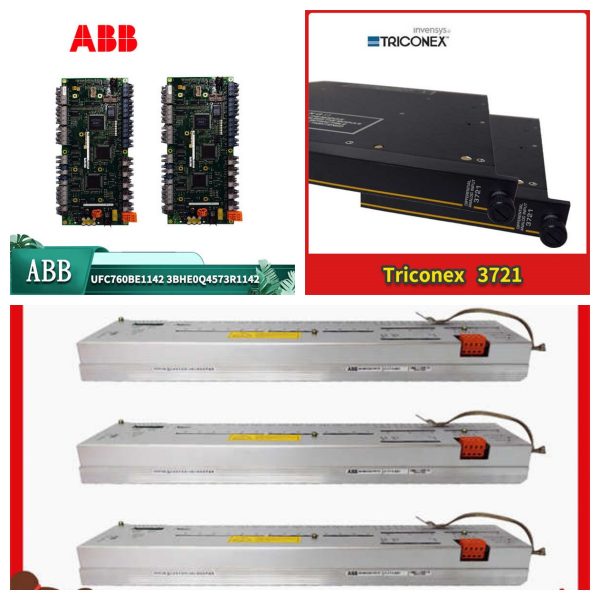
3721: Enhanced version of 3720 with extended diagnostics or updated firmware support (varies by revision).
Installation and Maintenance
Pre-installation preparation: Before inserting the 3720 into the Tricon chassis, confirm that the system firmware supports the module’s revision level and that the slot assignment matches the TriStation 1131 project configuration. Ensure the backplane is de-energized and grounded to prevent ESD damage. The 3720 must be fully seated and secured with the retention screw to maintain reliable contact with the Sync and Bus connectors essential for TMR synchronization.
Maintenance recommendations: Perform periodic loop checks using TriStation 1131’s built-in diagnostics to verify 3720 output accuracy and fault detection capability. Review system logs for intermittent alarms that may indicate early-stage component degradation. If replacement is required, use the “hot-swap” procedure only if explicitly enabled in the system configuration; otherwise, power down the chassis leg to avoid disrupting TMR synchronization. Always store spare 3720 modules in anti-static packaging at controlled temperature to preserve long-term reliability.