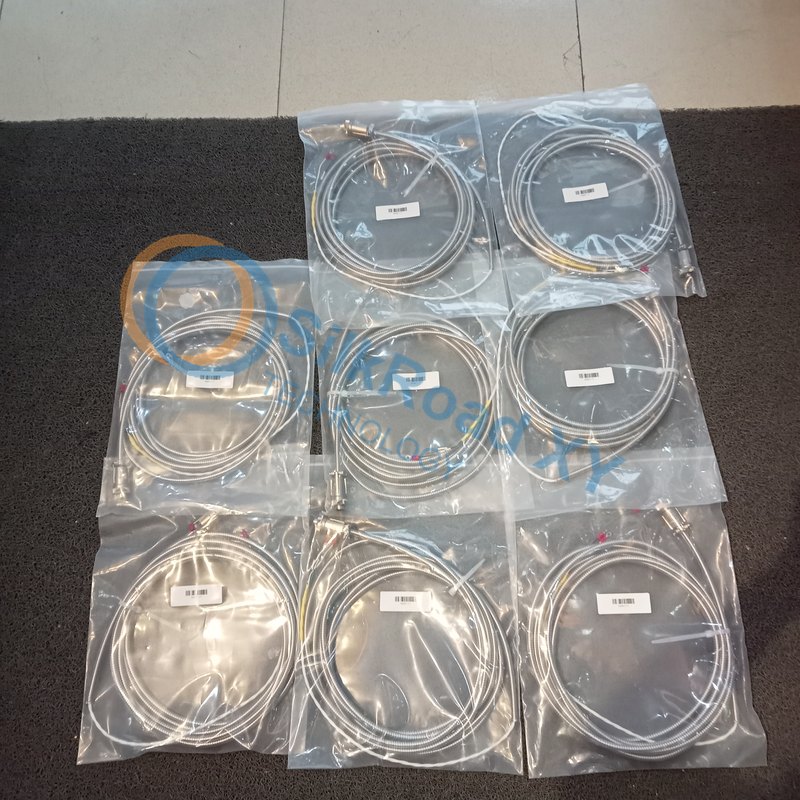


 Email: sales@slxytech.com
 WhatsApp / Wechat:8617062388866
 Phone:+86 17062388866
Description
The BENTLY NEVADA 1701/22 is a high-performance, four-channel dynamic signal monitor module designed for the industry-standard 3500 machinery protection system. As a core component of Bently Nevada’s flagship monitoring platform, the 1701/22 provides continuous, real-time acquisition and analysis of vibration, shaft displacement, and speed signals from proximity probes, velocity sensors, or accelerometers installed on critical rotating equipment such as turbines, compressors, pumps, and generators.
Engineered to meet API 670 standards for machinery protection, the BENTLY NEVADA 1701/22 converts raw transducer inputs into scalable engineering units (e.g., mils, microns, mm/s) and supports independent alarm and danger thresholds per channel with programmable relay logic. Each channel features BNC test points for easy field verification and calibration without system shutdown. The module communicates seamlessly with other 3500 components—including the 3500/20 rack interface, 3500/25 power supply, and 3500/42 monitor modules—enabling comprehensive condition monitoring and automatic trip functions when vibration exceeds safe limits. With its rugged design and precision signal conditioning, the 1701/22 ensures early fault detection and prevents catastrophic machine failure in demanding industrial environments.
 Technical Specifications
| Parameter Name | Parameter Value |
|---|---|
| Product Model | 1701/22 |
| Manufacturer | BENTLY NEVADA (a Baker Hughes Company) |
| Product Type | 4-Channel Dynamic Signal Monitor Module for 3500 System |
| Input Channels | 4 independent channels (accepts proximity probe, velocity sensor, or accelerometer) |
| Input Types | -24 VDC powered proximity probes (standard), AC-coupled velocity, IEPE accelerometers |
| Signal Conditioning | Anti-aliasing filter, 10 kHz bandwidth, 16-bit A/D conversion |
| Output | Scalable 4–20 mA (optional), relay contacts for alarm/danger per channel |
| Communication | Backplane communication via 3500 rack; no standalone protocol |
| Power Requirement | Supplied by 3500/25 or 3500/22M power supply (±12 VDC, +5 VDC via backplane) |
| Operating Temperature | 0°C to +65°C |
| Dimensions | Standard 3500 module: 241 mm H × 35 mm W × 229 mm D |
| Certifications | CE, UL, CSA, ATEX (for specific variants), compliant with API 670 |
Main Features and Advantages
High-fidelity signal acquisition for early fault detection:
The BENTLY NEVADA 1701/22 delivers laboratory-grade signal integrity in industrial settings, using precision front-end circuitry to accurately capture low-level dynamic signals from Bently Nevada proximity probes. Its wide bandwidth and anti-aliasing filters ensure that subtle changes in vibration signatures—such as those caused by bearing wear, misalignment, or rubs—are detected long before they escalate into failures. This enables predictive maintenance strategies that reduce unplanned downtime.
Flexible sensor compatibility and field verification:
Unlike fixed-input monitors, the 1701/22 supports multiple transducer types per channel, including standard -24 VDC proximity probes (e.g., 3300 series), moving-coil velocity sensors, and IEPE accelerometers—making it adaptable across legacy and modern installations. Each channel includes a front-panel BNC test point that outputs the conditioned signal, allowing technicians to validate probe health and signal quality with an oscilloscope or data collector without removing wiring or halting operations.
Integrated alarm logic with fail-safe reliability:
Each of the four channels on the BENTLY NEVADA 1701/22 features independently configurable alarm and danger thresholds with adjustable hysteresis and delay timers. Relay outputs can be wired to initiate local alarms or feed into a plant-wide ESD system. The module operates in full compliance with API 670 requirements for redundancy and voting logic when used in multi-module configurations, ensuring that spurious trips are minimized while maintaining safety integrity.
Seamless ecosystem integration within the 3500 platform:
As a native 3500-series module, the 1701/22 requires no external converters or gateways. It draws power and communicates via the backplane, automatically synchronizing with the 3500/20 rack interface for remote configuration through System 1 software. This plug-and-play architecture simplifies expansion, replacement, and diagnostics—critical for facilities managing hundreds of monitoring points across refineries, LNG trains, or combined-cycle power plants.
Application Field
The BENTLY NEVADA 1701/22 is widely deployed in continuous-process industries where rotating machinery uptime directly impacts safety, environmental compliance, and profitability. In oil and gas upstream and midstream operations, it monitors centrifugal compressors in gas gathering systems and pipeline booster stations, detecting imbalance or surge conditions before seal damage occurs. In petrochemical refineries, the 1701/22 protects critical hydrocracker and FCCU blowers, where excessive vibration could trigger a unit shutdown costing millions per day.
In power generation, the BENTLY NEVADA 1701/22 is integral to steam and gas turbine monitoring, tracking radial vibration, axial thrust position, and differential expansion during startup, synchronization, and load changes. Nuclear and fossil fuel plants rely on its API 670-compliant architecture for regulatory reporting and automatic turbine trip coordination. Similarly, in pulp and paper mills, the 1701/22 safeguards large dryer cans and turbofans, where bearing degradation can lead to fire hazards. Because of its proven track record in harsh electromagnetic and thermal environments, the 1701/22 remains a go-to solution for asset-intensive industries seeking reliable, code-compliant machinery protection.
 Related Products
3500/22M: Enhanced version with 4–20 mA analog outputs per channel; backward compatible with 1701/22 rack
3500/42: Dual-channel monitor with similar functionality but limited to 2 inputs; often used alongside 1701/22
3300/80: Proximity probe system commonly paired with 1701/22 for shaft displacement measurement
3500/20: Rack interface module required for communication between 1701/22 and System 1 software
3500/25: Redundant power supply module that powers the 1701/22 and other 3500 cards
1701/40: Older 2-channel version; 1701/22 offers double the density and improved filtering
3500/32: 4-channel relay module used to expand alarm output capacity for 1701/22 signals
Installation and Maintenance
Pre-installation preparation: Before installing the BENTLY NEVADA 1701/22, confirm that the 3500 rack is powered by a properly configured 3500/25 or 3500/22M power supply and that the 3500/20 interface module is active. Ensure all proximity probe cables are shielded, grounded at one end only, and routed away from high-voltage conductors. Insert the 1701/22 firmly into an available slot in the 3500 chassis until the ejector levers click into place. Verify that the keying on the module matches the rack to prevent misinsertion. Use the BNC test points to inject a known signal during commissioning to validate scaling and alarm thresholds.
Maintenance recommendations: The BENTLY NEVADA 1701/22 has no moving parts and requires no routine calibration under normal conditions. However, perform annual functional checks using a signal simulator or portable calibrator to verify alarm activation and relay operation. Inspect front-panel LEDs for fault indications (e.g., “Not OK” status). Keep firmware and System 1 database backups current to facilitate rapid replacement if needed. If a 1701/22 fails, replace it with a like-for-like unit—configuration is stored in the 3500/20 module, so no reprogramming is required. Store spare units in static-safe packaging at controlled temperature and humidity to preserve electronic integrity.