
 Email: sales@slxytech.com
 WhatsApp / Wechat:8617062388866
 Phone:+86 17062388866
Description
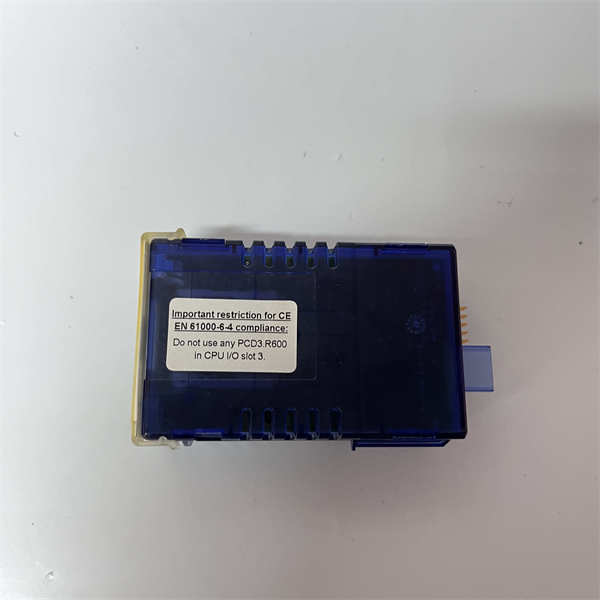
The SAIA PCD3.R60X is a high-performance programmable logic controller (PLC) from the SAIA PCD®3 series, engineered for advanced building automation and industrial control applications. As a core component of Sauter Automation’s ecosystem, this modular controller delivers robust processing power with its RISC-based CPU, supporting complex automation tasks across HVAC, energy management, lighting control, and security systems. The PCD3.R60X features integrated RAM memory with battery backup, ensuring program retention during power outages – a critical requirement for building management systems (BMS). Its modular architecture allows flexible expansion with up to 128 I/O points via SAIA’s FG (Function Group) modules, enabling tailored solutions for projects ranging from single-room controls to multi-building campuses.
Designed for reliability in demanding environments, the SAIA PCD3.R60X operates within a wide temperature range (-25°C to +55°C) and offers comprehensive communication capabilities including native BACnet/IP, Modbus RTU/TCP, and SAIA S-Bus protocols. This versatility allows seamless integration with third-party devices and building management software. The controller executes PID loops, scheduling, alarm management, and data logging locally, reducing dependency on central servers. Certified to EN 60730 for household applications and IEC 61131 for industrial use, the PCD3.R60X bridges the gap between facility automation and process control, providing engineers with a unified platform for optimizing energy efficiency and operational reliability.
SAIA PCD3.R60X
Technical Specifications
| Parameter Name | Parameter Value |
| Product Model | PCD3.R60X |
| Manufacturer | SAIA-Burgess Controls (Sauter Group) |
| Product Type | Modular Programmable Logic Controller |
| CPU Architecture | 32-bit RISC Processor |
| Program Memory | 10 MB RAM (battery-backed) |
| Data Memory | 4 MB Flash |
| Max I/O Capacity | 128 points (via expansion modules) |
| Communication Ports | 1x Ethernet (10/100 Mbps), 2x RS-485 |
| Protocols | BACnet/IP, Modbus RTU/TCP, SAIA S-Bus, SNMP |
| Real-Time Clock | Integrated with battery backup |
| Operating Voltage | 24 VDC (19.2–28.8 VDC) |
| Power Consumption | 1.8 W (typical) |
| Operating Temperature | -25°C to +55°C |
| Certifications | CE, UL, EN 60730-1, IEC 61131-2 |
| Dimensions | 106 x 127 x 65 mm (H x W x D) |
Main Features and Advantages
Advanced Connectivity: The SAIA PCD3.R60X excels in multi-protocol integration with native BACnet/IP (B-ASC) and Modbus stacks, eliminating the need for external gateways. Its dual RS-485 ports support daisy-chaining of peripherals like touch panels, energy meters, and I/O expansions via SAIA S-Bus, reducing wiring costs by up to 40%. The Ethernet port enables web server access for real-time monitoring and configuration without dedicated software.
Robust Control Capabilities: Featuring a high-speed RISC processor, the controller executes complex control sequences including 16 parallel PID loops for precise HVAC regulation. Integrated scheduling engines manage time-based events (e.g., lighting scenes, temperature setbacks), while the data logger stores 100,000+ timestamped alarms and process values locally. Cybersecurity is prioritized with password protection, VLAN support, and role-based access control.
Modular Flexibility: The base unit supports plug-in expansion modules including digital I/O (FG-DIO111), analog inputs (FG-AI114), and communication cards (FG-ETH for additional Ethernet ports). Hot-swappable design allows maintenance without system shutdown. The lithium battery backup (10-year life) ensures program retention during extended power failures. Conformal coating protects against humidity and dust in mechanical rooms.
Application Field
The SAIA PCD3.R60X dominates intelligent building automation, controlling HVAC systems in commercial offices, hospitals, and universities. It sequences chillers/boilers, manages VAV boxes, and monitors air quality sensors to ensure ASHRAE compliance. In industrial facilities, it automates lighting control via DALI/KNX gateways and integrates access control systems through its I/O expansions.
Energy management is a core application: the controller interfaces with power meters (SAIA FDPS series) to optimize consumption through load shedding and peak shaving algorithms. For renewable energy projects, it coordinates solar inverters and battery storage via Modbus TCP. In critical environments like laboratories, the PCD3.R60X maintains pressure cascades and fume hood safety controls with SIL-capable logic. Its rugged design suits installations in electrical cabinets, plant floors, and outdoor kiosks.
SAIA PCD3.R60X
Related Products
PCD3.M60X: Same CPU with extended memory (16 MB Flash) for data-intensive applications.
FG-DIO111: 8-channel digital I/O module for expanding PCD3.R60X point capacity.
FG-AI114: 4-channel analog input module (0-10V/4-20mA) for sensor integration.
PCD7.D510: High-end controller for larger BMS projects requiring more processing power.
PG5-WEB: Web server module for cloud connectivity and remote access.
SAIA VD4.8: Operator touch panel for local control and visualization.
FG-ETH: Additional Ethernet port module for network segmentation.
SAIA FDPS: Power quality analyzer for energy monitoring systems.
FG-MBUS: M-Bus master module for utility meter integration.
Installation and Maintenance
Pre-installation preparation: Verify ambient temperature falls within -25°C to +55°C range at the mounting location. Ensure DIN rail (EN 60715) is securely fixed in the control panel. Prepare shielded CAT5e cables for Ethernet communications, separating them from power lines by at least 20 cm. Configure IP addresses and BACnet Device IDs using SAIA PG5 Suite software before physical installation. Check lithium battery voltage (>2.8 V) if storing the PCD3.R60X long-term.
Maintenance recommendations: Monitor the controller’s “BATT” LED annually – a red indicator signals imminent battery replacement. Back up applications quarterly using PG5 Suite. Clean ventilation slots with low-pressure air to prevent dust accumulation. Update firmware during planned outages to access security patches and feature enhancements. For I/O modules, cycle power before replacing to avoid bus conflicts. Validate critical control parameters (e.g., PID constants) after firmware updates to ensure operational continuity.