
 Email: sales@slxytech.com
 WhatsApp / Wechat:8617062388866
 Phone:+86 17062388866
Description
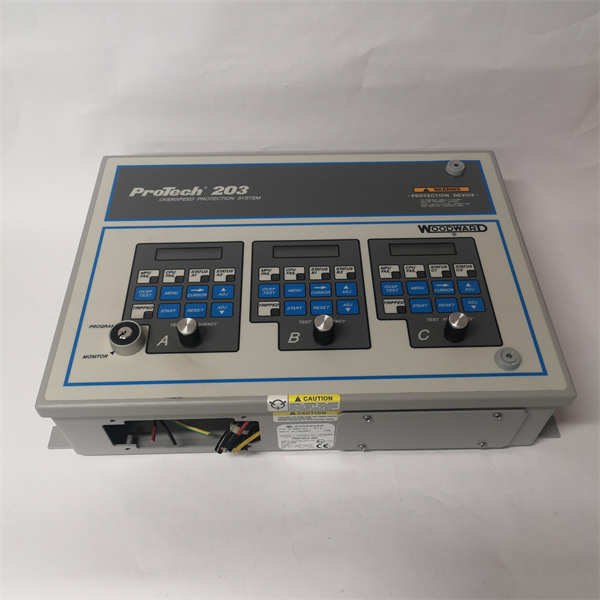
The WOODWARD 9907-147 is a high-precision Digital Electro-Hydraulic Actuator Controller Module from Woodward’s acclaimed SPC (Smart Position Controller) valve control family, engineered for critical turbine, engine, and compressor control applications. This ruggedized module serves as the intelligence behind precise valve positioning in demanding industrial environments, translating control signals into accurate hydraulic actuator movements. Designed for seamless integration within Woodward’s ProAct™ digital control platforms and legacy systems, the 9907-147 excels in regulating fuel, steam, air, or other process flows with exceptional accuracy and dynamic response. Its core function involves closed-loop position control using LVDT/RVDT feedback, executing sophisticated PID algorithms to maintain setpoints despite load variations and disturbances. As a cornerstone of mission-critical speed/load control systems, the WOODWARD 9907-147 delivers unparalleled reliability, ensuring operational stability, safety, and efficiency for prime movers. Its value lies in minimizing process variability, preventing overspeed events, optimizing combustion, and extending equipment lifespan through precise, repeatable control under extreme conditions.
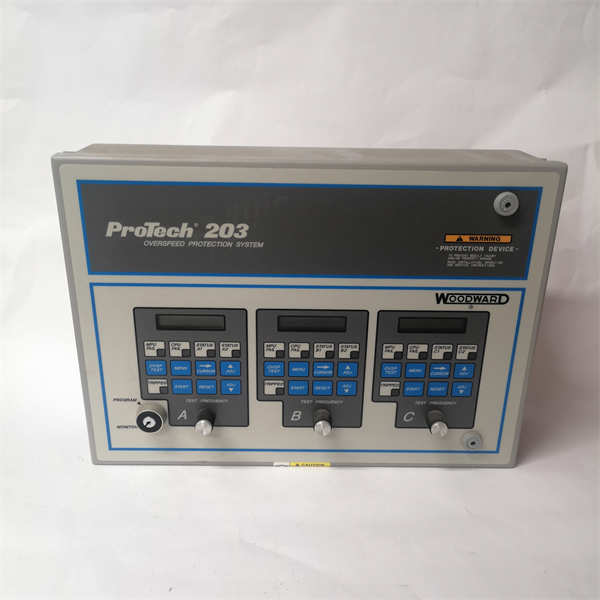
WOODWARD 9907-147
Technical Specifications
| Parameter Name | Parameter Value |
| Product Model | 9907-147 |
| Manufacturer | Woodward |
| Product Type | Electro-Hydraulic Actuator Controller Module |
| Input Power | 20-30 VDC (Nominal) |
| Position Feedback Input | LVDT/RVDT (2-wire or 4-wire, configurable) |
| Command Signal Input | 4-20 mA, ±20 mA, or 0-10 VDC (Configurable) |
| Output Signal (Drive) | ±80 mA (Max) for Servo Valve / Proportional Valve |
| Control Algorithm | Advanced PID with Adaptive Tuning, Non-Linear Compensation |
| Position Accuracy | < ±0.1% Full Scale (Typical) |
| Response Time | < 20> |
| Communication Interface | RS-232/RS-485 (Modbus RTU) for Configuration/Monitoring |
| Operating Temperature | -40°C to +85°C (-40°F to +185°F) |
| Vibration Resistance | 5 g RMS (10-500 Hz) |
| Shock Resistance | 40 g (11 ms duration) |
| Hazardous Location Certification | ATEX / IECEx Zone 2 (Optional, specific variants) |
| Enclosure Rating | IP20 (Typically requires panel mounting) |
| Dimensions (H x W x D) | Approx. 200 mm x 120 mm x 50 mm (7.87″ x 4.72″ x 1.97″) |
Main Features and Advantages
The WOODWARD 9907-147 delivers exceptional control precision through its advanced adaptive PID algorithms and sophisticated signal conditioning. It continuously monitors LVDT/RVDT position feedback and dynamically adjusts servo valve drive signals to achieve and maintain commanded setpoints with minimal error, even under rapidly changing load conditions or significant mechanical friction variations. This adaptability translates directly to smoother process operation and tighter control loops. Its robust design is a key advantage; built to withstand the harsh environments typical of power generation, oil & gas, and marine applications, the 9907-147 features high immunity to electrical noise, extreme temperature tolerance, and significant resistance to shock and vibration, ensuring reliable operation where lesser controllers would fail.
Integrated diagnostics and comprehensive monitoring capabilities significantly enhance system availability. The module continuously performs self-checks on critical functions and provides detailed status information (position, command, error, alarms) via its communication port, enabling predictive maintenance and rapid troubleshooting. Configuration flexibility is another major strength; the WOODWARD 9907-147 can be easily tuned and calibrated using Woodward’s proprietary service tools (e.g., ToolKit™ software) over RS-232/485, allowing optimization for specific valve characteristics and application dynamics. Features like adjustable gain settings, customizable ramping, and configurable limit alarms provide engineers with fine-grained control over actuator performance. Furthermore, its proven track record in safety-critical applications like turbine overspeed protection underscores its inherent reliability and deterministic response, making the 9907-147 a trusted component for protecting high-value assets.
Application Field
The WOODWARD 9907-147 finds its primary application in regulating critical valves for prime movers and large rotating equipment across energy and heavy industry. In gas turbine control, it is indispensable for precisely positioning fuel gas control valves, inlet guide vanes (IGVs), and compressor bleed valves, directly impacting efficiency, emissions, and load response. Its speed and accuracy are crucial for preventing turbine overspeed during load rejections. For steam turbines, the 9907-147 accurately governs steam admission valves (throttle, intercept, extraction) to maintain precise speed or load control, essential for grid stability in power plants and mechanical drive applications in refineries or chemical plants. Large industrial engines driving compressors or generators rely on the WOODWARD 9907-147 for fuel rack or throttle valve control, ensuring stable operation under varying loads.
Beyond turbines and engines, the 9907-147 excels in controlling compressor anti-surge valves, where rapid and precise modulation is vital to prevent damaging surge conditions in centrifugal and axial compressors used in pipelines, LNG plants, and petrochemical facilities. It also regulates critical control valves in hydroturbine governors, boiler feedwater systems, and large industrial process lines requiring high-fidelity flow control. Essentially, any application demanding extremely accurate, reliable, and fast valve positioning for critical processes involving fluids (gas, liquid, steam) under challenging environmental conditions is a prime candidate for the robust performance of the WOODWARD 9907-147.
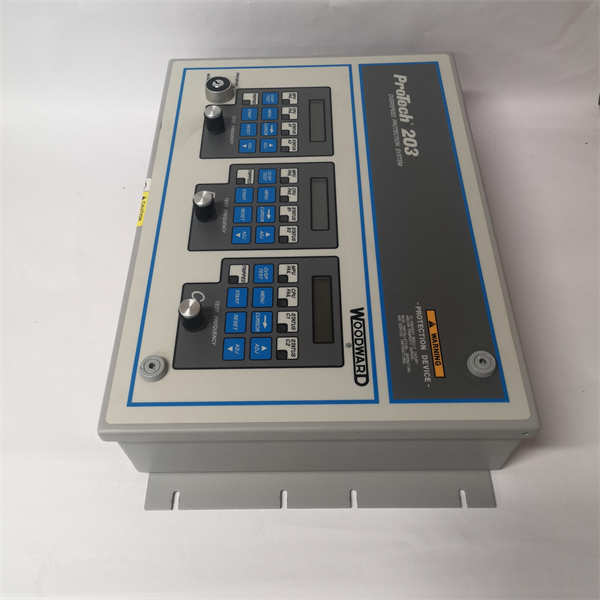
WOODWARD 9907-147
Related Products
9907-167: An advanced version offering enhanced communication protocols (e.g., CANopen) and potentially faster processing compared to the 9907-147.
9907-118 / 9907-128: Common predecessors or variants within the SPC family, potentially differing in I/O options or specific performance characteristics relative to the 9907-147.
9907-164: A specialized SPC module often used for actuator control in specific gas turbine fuel systems or as a secondary controller.
2301D / 2301E: Woodward’s classic mechanical-hydraulic speed governors; the 9907-147 provides digital actuator control often interfacing with or replacing parts of these systems.
505/505XT: Woodward’s digital speed control units; the 9907-147 frequently acts as the actuator controller (position loop) receiving speed/load signals from these units.
ProAct™ PLC: Woodward’s modern control platform; the 9907-147 can be integrated as a dedicated actuator controller within a ProAct system.
LVDT/RVDT Sensors (e.g., 8236-xxx): Woodward’s position feedback sensors, essential for providing the closed-loop input to the 9907-147.
Servo Valves (e.g., SVI2/SVI3): Woodward servo valves directly driven by the output current from the 9907-147.
ToolKit™ Software: Woodward’s essential configuration, calibration, monitoring, and diagnostic software for the 9907-147 and other controllers.
Installation and Maintenance
Pre-installation preparation: Before installing the WOODWARD 9907-147, ensure the system power is completely isolated and locked out/tagged out according to strict safety protocols. Carefully inspect the module and associated wiring harnesses for any physical damage. Verify the mounting location meets environmental specifications (temperature, vibration, humidity) and provides adequate clearance for cooling and cable routing. Ensure the mounting panel is properly grounded. Gather all necessary documentation: module manual, system schematic, and calibration procedures. Confirm compatibility of the power supply, command signal source, position feedback sensors (LVDT/RVDT), and the servo/proportional valve. Have the correct Woodward service tools (e.g., ToolKit™ software, compatible interface cable) and calibration equipment ready. Review wiring diagrams meticulously to ensure correct connections for power, command input, position feedback, valve drive output, and communication ports for the 9907-147.
Maintenance recommendations: Regular maintenance for the WOODWARD 9907-147 focuses on monitoring and inspection. Utilize the module’s communication interface and ToolKit™ software to periodically review operational parameters (position, command, error), diagnostic status bits, and any logged alarms or events. Visually inspect the module and its connections during routine shutdowns for signs of corrosion, loose terminals, damaged wiring, or contamination. Ensure ventilation slots are clear of dust and debris. Perform scheduled calibration verification according to Woodward procedures and plant maintenance schedules, checking the alignment between command signal, actual valve position (via LVDT/RVDT), and the controller’s internal indication. Firmware updates should only be applied if specifically recommended by Woodward for resolving identified issues and must be performed following strict procedures after backing up the current configuration. Maintain clean, secure electrical connections to prevent noise issues. If module replacement is necessary, ensure the replacement 9907-147 is correctly configured and calibrated before commissioning.