
 Email: sales@slxytech.com
 WhatsApp / Wechat:8617062388866
 Phone:+86 17062388866
Description
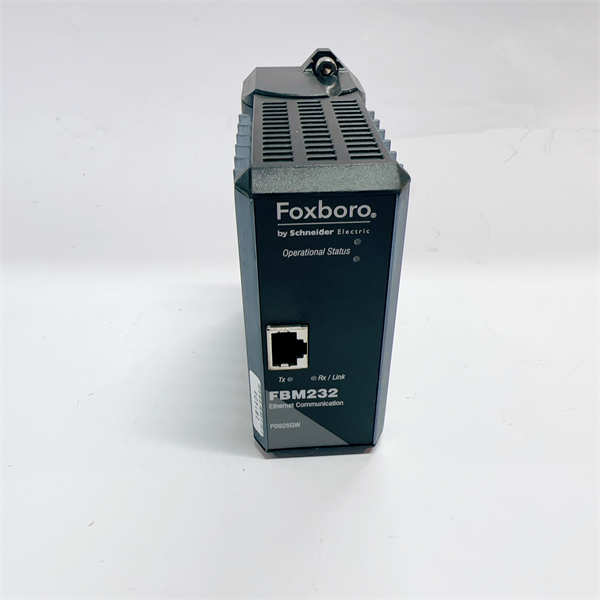
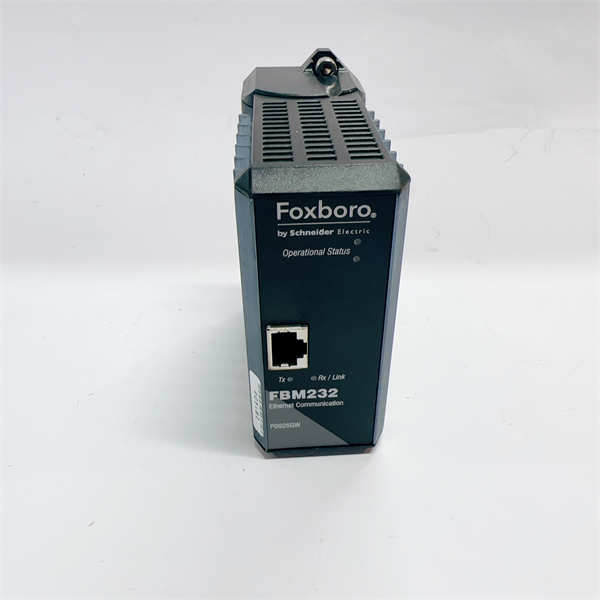
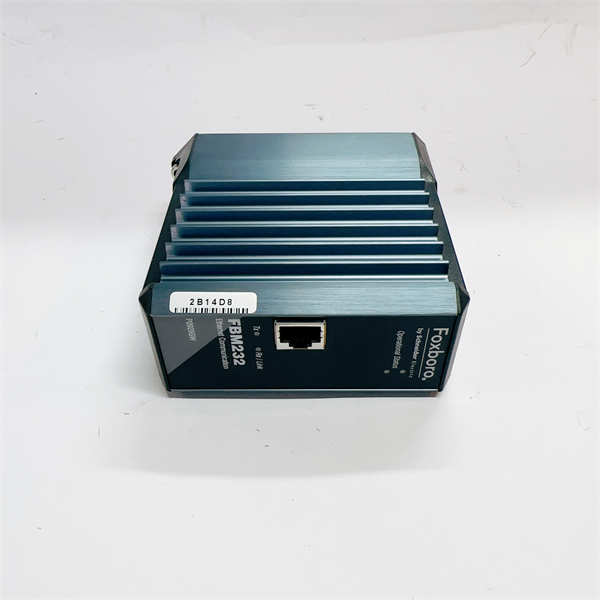
The FOXBORO FBM232 P0926GW is a high-density *16-Channel Analog Input Module* for the Foxboro I/A Series Distributed Control System (DCS), engineered to deliver precision signal acquisition in demanding process industries. Designed as a critical component of Foxboro’s Fieldbus Module (FBM) family, this module interfaces with analog sensors and transmitters to convert real-world process variables – including temperature, pressure, flow, and level – into digital data for control and monitoring. The FBM232 P0926GW supports multiple input types (voltage: 0-5V, ±5V; current: 4-20mA) with 16-bit resolution and ±0.05% accuracy, ensuring reliable data integrity for safety-critical applications in refineries, power plants, and chemical facilities.
Featuring channel-to-channel isolation and advanced noise rejection circuitry, the module maintains signal fidelity in electrically noisy environments like motor control centers or substations. Its hot-swappable design enables replacement without system shutdown, minimizing production losses during maintenance. Compatible with Foxboro FBM200-series racks, the FBM232 P0926GW integrates seamlessly with I/A Series control processors, providing scalable I/O expansion for both greenfield installations and legacy system upgrades. With a -40°C to +70°C operating range and conformal-coated electronics, this module exemplifies Schneider Electric’s commitment to robust, long-lifecycle industrial automation solutions.
FOXBORO FBM232 P0926GW
Technical Specifications
| Parameter Name | Parameter Value |
| Product Model | FBM232 P0926GW |
| Manufacturer | FOXBORO (Schneider Electric) |
| Product Type | Analog Input Module |
| Channels | 16 (single-ended) |
| Input Types | Voltage (0-5V, ±5V), Current (4-20mA) |
| Resolution | 16-bit |
| Accuracy | ±0.05% full scale |
| Sampling Rate | 10 samples/sec (aggregate) |
| Input Impedance | >1 MΩ (voltage), 250 Ω (current) |
| Isolation | 250V AC channel-to-channel |
| Operating Temperature | -40°C to +70°C |
| Power Supply | 5V DC (via FBM backplane) |
| Power Consumption | 1.8W (typical) |
| Communication | Foxboro FBM Bus |
| Certifications | UL, ATEX, IECEx, cFMus |
| Dimensions | 130 mm x 45 mm x 120 mm (H x W x D) |
Main Features and Advantages
Precision Signal Conditioning: The FBM232 P0926GW delivers laboratory-grade accuracy (±0.05%) with programmable filtering to eliminate noise from VFDs or switching power supplies. Auto-calibration routines compensate for temperature drift, ensuring consistent measurements in refinery crude units or boiler systems.
Flexible Configuration: Each channel independently configures for voltage or current inputs via software, eliminating external signal converters. Open-wire detection for current loops alerts operators to broken thermocouple wires in critical temperature monitoring.
High Availability Design: Hot-swap capability allows module replacement without rack shutdown. Dual-wire termination blocks prevent vibration-induced loosening in compressor stations. Status LEDs per channel provide instant visual diagnostics for field wiring faults.
Legacy System Integration: Backward-compatible with all I/A Series control processors (CP40/CP60). Supports Foxboro’s legacy Point Database (PDB) structure for seamless migration from older FBM models without software rewrites.
Application Field
The FBM232 P0926GW excels in continuous process monitoring:
Oil & Gas: Tracks separator vessel pressures and pipeline corrosion monitoring currents in offshore platforms.
Power Generation: Acquires boiler drum level transmitter signals and turbine bearing temperatures.
Chemical Processing: Monitors reactor jacket temperatures and catalyst feed rates with 4-20mA inputs.
Water Treatment: Measures filter differential pressures and chlorine analyzer outputs.
Pharmaceutical: Provides FDA 21 CFR Part 11-compliant batch process variable recording.
Mining: Interfaces with slurry density meters in mineral processing plants.
Related Products
FBM217: 8-channel analog output module for valve control.
FBM242: 32-channel digital input module for contact monitoring.
FBM247: 16-channel digital output for solenoid control.
P0916PY: Alternate revision of FBM232 with enhanced EMC protection.
FBM204: Redundant power supply for FBM racks.
CP60: Control processor executing logic with FBM232 P0926GW data.
FBM231: 8-channel analog input module for space-constrained installations.
FOXBORO FBM232 P0926GW
Installation and Maintenance
Pre-installation preparation: Verify FBM rack compatibility (e.g., FBM218 carrier). Configure channel parameters in Foxboro I/A Series software before insertion. Discharge static electricity via wrist strap. Ensure proper grounding of field wiring shields at single-point earth.
Maintenance recommendations: Perform channel accuracy verification annually using precision calibrator. Clean terminal blocks with electronic contact cleaner during shutdowns. Replace the FBM232 P0926GW hot-swap by releasing the extraction lever before removal. Monitor module status via Foxboro Alarm Management System for early fault detection.