
 Email: sales@slxytech.com
 WhatsApp / Wechat:8617062388866
 Phone:+86 17062388866
Description
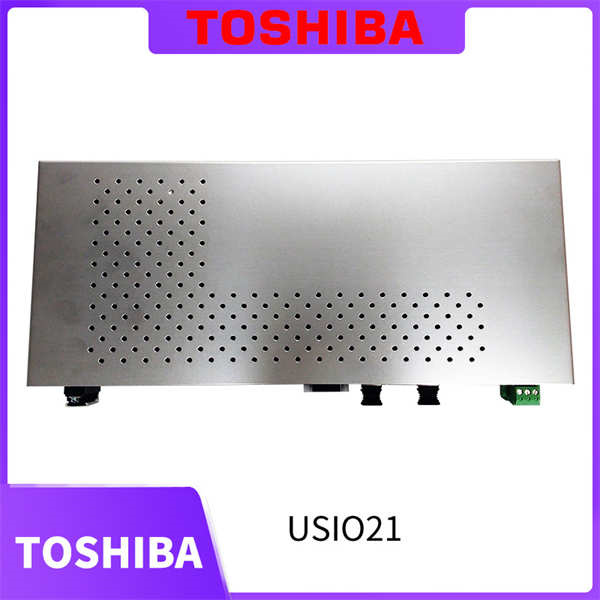
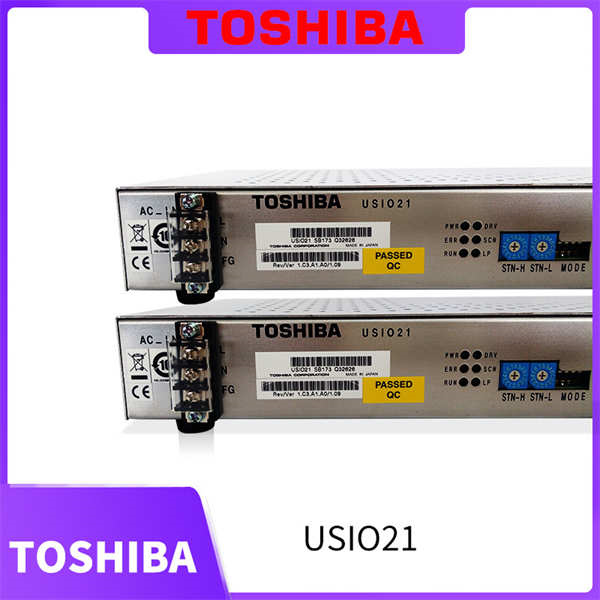
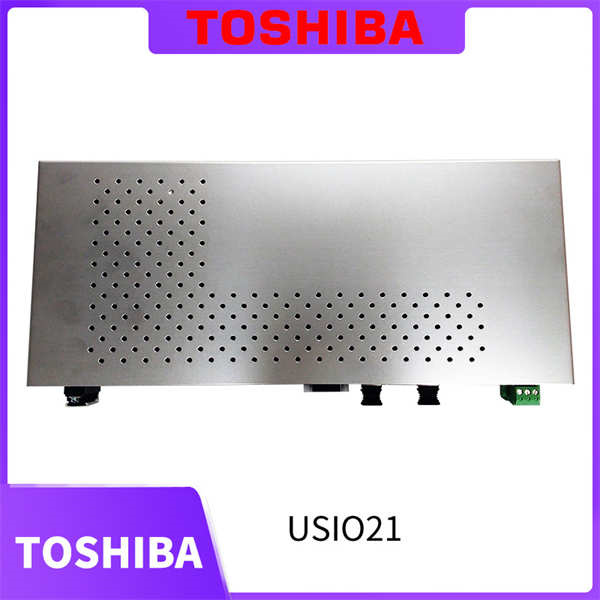
The TOSHIBA USIO21 is a robust and reliable digital input/output (I/O) module engineered for integration into TOSHIBA’s advanced industrial control systems, particularly in power generation, turbine control, and large-scale process automation applications. As a key component of TOSHIBA’s control architecture, the TOSHIBA USIO21 delivers high-speed signal processing, precise timing control, and seamless communication with central processing units in distributed control systems (DCS). Designed for mission-critical environments, the TOSHIBA USIO21 supports a wide range of discrete signal types, enabling real-time monitoring and control of field devices such as sensors, actuators, relays, and motor starters. Its modular design ensures easy integration into existing control racks, supporting hot-swap capability to minimize system downtime during maintenance or expansion. Built with industrial-grade components and rigorous electromagnetic compatibility (EMC) protection, this module ensures stable operation in harsh environments characterized by high vibration, temperature fluctuations, and electrical noise. The TOSHIBA USIO21 is particularly valued in power plant control systems where reliability, signal integrity, and deterministic response times are paramount. With its proven track record in legacy TOSHIBA turbine control systems, the module continues to be a trusted solution for system upgrades and replacements in aging infrastructure.
TOSHIBA USIO21
Technical Specifications
Product Model | USIO21
Manufacturer | TOSHIBA
Product Type | Digital I/O Module
Function Type | Discrete Input/Output Interface
Channel Count | 32 Channels (Configurable Input/Output)
Input Voltage Range | 24–48 VDC (Typical)
Output Type | Solid-State Relay or Transistor (Sink/Source)
Signal Isolation | Optical Isolation (Channel-to-Channel and Backplane)
Isolation Voltage | 1500 VAC (Typical)
Response Time | < 2>
Operating Temperature | 0°C to 60°C
Storage Temperature | -20°C to 80°C
Humidity Range | 5% to 95% RH (Non-condensing)
Installation Type | DIN Rail or Rack Mount (TOSHIBA Control Frame)
Main Features and Advantages
The TOSHIBA USIO21 stands out for its exceptional reliability and flexibility in industrial control applications. Its configurable I/O channels allow engineers to tailor the module’s functionality to specific system requirements, reducing the need for multiple dedicated modules and lowering overall system complexity and cost. The optical isolation across all channels ensures high noise immunity, protecting the central controller from voltage surges and ground loops—critical in high-power environments such as turbine halls and switchgear rooms. The fast response time guarantees precise timing in safety-critical sequences, such as emergency shutdowns or valve actuation, where milliseconds can impact system safety. The TOSHIBA USIO21 also supports hot-swapping, enabling maintenance and module replacement without powering down the entire control system, thereby maximizing operational uptime. Its compatibility with TOSHIBA’s legacy control platforms ensures seamless integration into existing infrastructures, making it ideal for retrofit projects and life-extension programs in aging power plants. Furthermore, the module’s diagnostic capabilities, including LED status indicators for each channel, simplify troubleshooting and reduce mean time to repair (MTTR). The TOSHIBA USIO21 is built to meet stringent industrial standards, ensuring long-term performance in demanding conditions. Its proven design has been deployed in hundreds of installations worldwide, reinforcing its reputation as a dependable component in critical control loops.
Application Field
The TOSHIBA USIO21 is primarily deployed in heavy industrial sectors where high-reliability digital I/O control is essential. Its most prominent application is in thermal, nuclear, and hydroelectric power plants, where it interfaces with turbine control systems, boiler management systems, and auxiliary plant equipment. In these environments, the TOSHIBA USIO21 monitors status signals from pressure switches, temperature sensors, and position indicators while commanding outputs to solenoid valves, contactors, and alarm systems. It is also widely used in large-scale manufacturing facilities, including steel mills and petrochemical plants, for sequence control, interlock logic, and machine safety functions. The module’s robust design makes it suitable for deployment in control panels located in electrically noisy or physically harsh areas, such as near transformers, motors, or outdoor switchyards. Additionally, the TOSHIBA USIO21 plays a vital role in system modernization projects, where legacy TOSHIBA control systems are being upgraded or replaced incrementally. Engineers rely on the TOSHIBA USIO21 to maintain compatibility with existing wiring and control logic while improving system availability and maintainability. Its use extends to test benches and simulation systems for validating control logic before field deployment, ensuring operational integrity.
Related Products
USIO22: Similar digital I/O module with enhanced channel density and faster update rates, often used as a performance upgrade.
USIO11: Earlier generation digital input module with fixed configuration, compatible with the same control rack.
USIO31: Analog input module for integration with temperature, pressure, and flow sensors in the same system.
USPU11: Central processing unit module designed to work with USIO series for complete control system builds.
USPS21: Power supply module optimized for TOSHIBA USIO series, ensuring stable voltage delivery.
USRT11: Real-time clock module that synchronizes timing across USIO21 and other I/O modules for event logging.
USBC11: Bus coupler module enabling communication between multiple racks in distributed configurations.
USMM11: Memory module for expanding program and data storage capacity in USPU11-based systems.
TOSHIBA USIO21
Installation and Maintenance
Pre-installation preparation: Before installing the TOSHIBA USIO21, ensure the control cabinet is de-energized and all safety procedures are followed. Verify that the rack type (e.g., USR11 or compatible) supports the module and that the backplane is free of dust or debris. Confirm the power supply voltage matches the module’s requirements and that grounding is properly established. Use the alignment guide to insert the module firmly into the slot, ensuring the connector is fully seated. Secure the module using the side clips or screws as specified in the manual. After installation, power up the system and verify LED indicators for power, communication, and channel status.
Maintenance recommendations: Regularly inspect the TOSHIBA USIO21 for signs of overheating, dust accumulation, or loose connections. Clean the module and surrounding area during scheduled maintenance outages using compressed air. Monitor LED diagnostics to detect failing channels early. Avoid exposing the module to moisture or corrosive gases. If a fault occurs, replace the module using hot-swap procedures if supported by the system configuration. Always store spare modules in anti-static packaging in a dry, temperature-controlled environment.